Flight shapesDiamond DA20 KatanaReception source: ADS-B, ICAO address
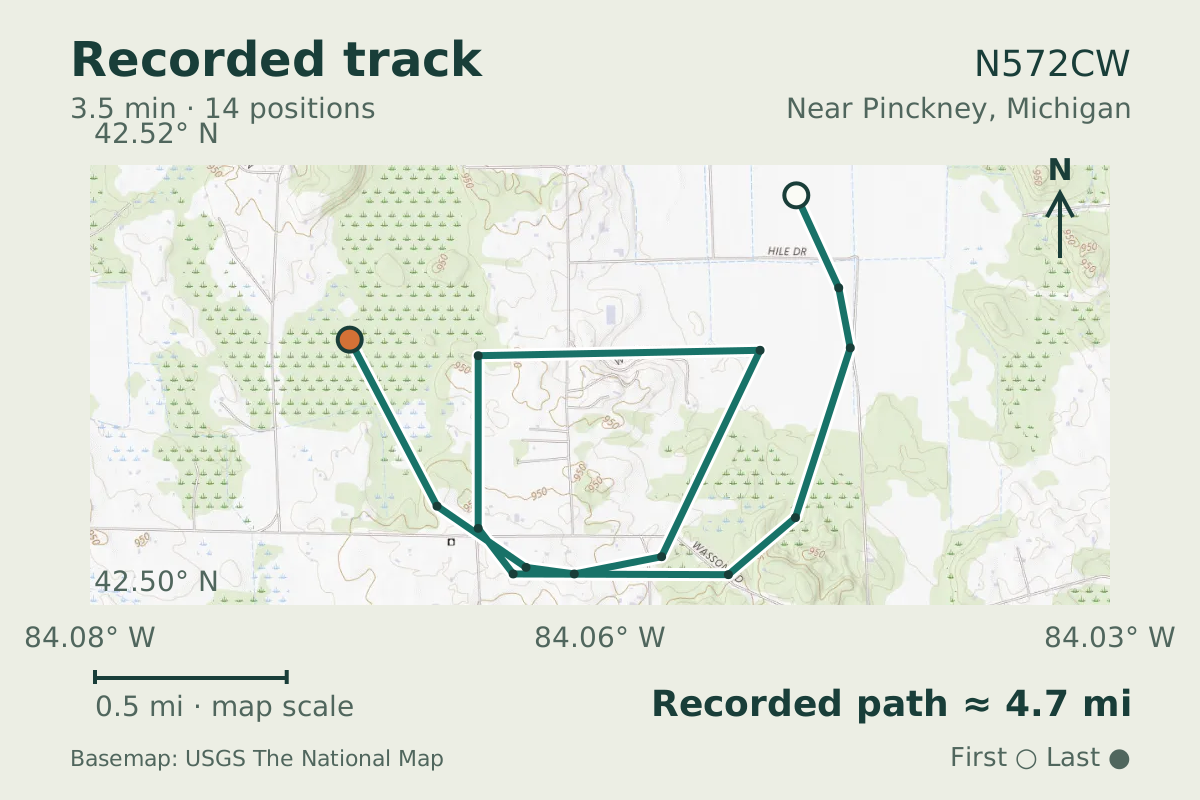
Diamond DA20 Katana N572CW draws a descending loop
The Katana provided the basis for the four-seat DA40. This observation traces a closed loop with a 1,900-foot loss of altitude.
- Replay time · UTC
- —
- Last saved report · UTC
- —
- Recorded path
- —
- Reported ground speed
- —
- Archived altitude
- —
The dot moves between saved positions. Readings are from the last saved report. Recorded path is approximate and excludes gaps. Distances use nautical miles (nmi); speed uses knots (nmi per hour).
The Katana design that provided the basis for the four-seat DA40 appears in this observation as a descending loop near Pinckney, Michigan. N572CW, listed as a Diamond DA20 Katana in the aircraft database, traced the shape on October 19, 2026.
The track contains one closed loop and an altitude loss of 1,900 feet. A ground-speed report of 88 knots adds a detail to the picture of the flight. The DV20 Katana type first flew in 1991.
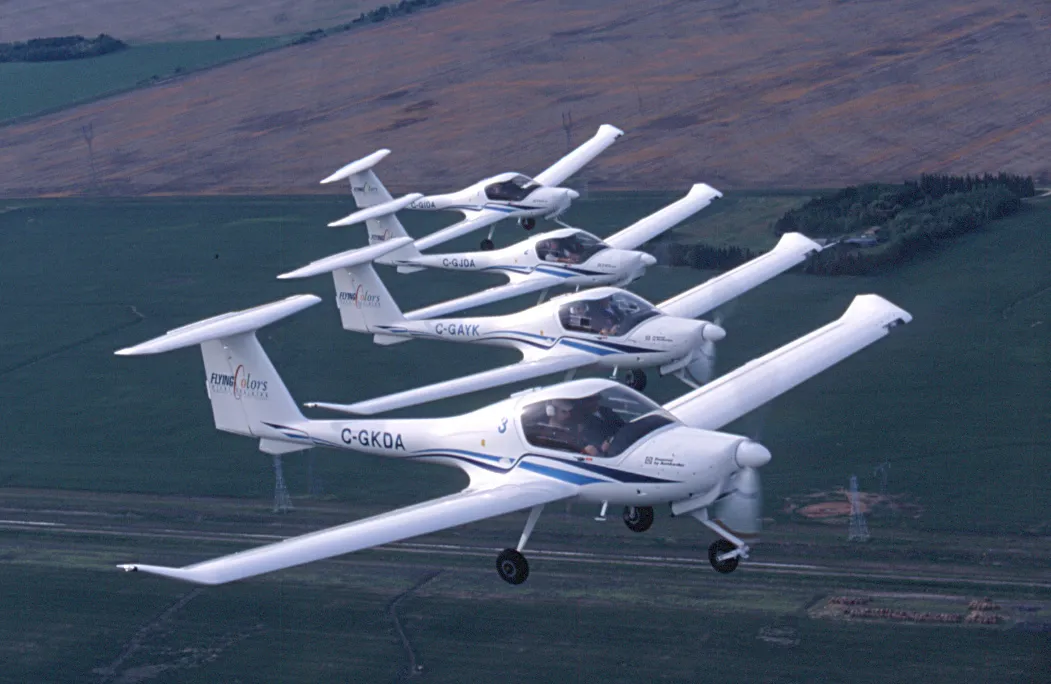
About the Diamond DA20 Katana
- The DV20 Katana first flew in 1991.
- The DV20 Katana provided the basis for development of the four seat DA40.
Other Diamond DA20 Katana stories
Why this was our weekly pick
The DV20 Katana grew from the HK36 motor glider, first flew in 1991, and had an approved Rotax 912 S3 engine retrofit.
From motor glider to Katana
Aircraft type background
The DV20 Katana first flew in 1991, according to Diamond's historical timeline. Its origins reach back to the HK36 motor glider. In Diamond's account of the development, engineer Martin Volck recalled that the Joint Aviation Authorities' early-1990s Very Light Aircraft specification suggested a way to adapt the HK36 with relatively little development work. That ancestry makes the Katana worth noticing: its development began with an existing motor-glider design. Diamond's earlier history also records production of the H36 Dimona beginning in 1981 and the HK36 Super Dimona beginning in 1987. [1] [2]
What the names mean
Aircraft type background
Volck explained that the original DV designation combined Dries and Volck. With the Canadian operation came DA20, with the letters standing for Diamond Aircraft; that naming was subsequently used for the European version as well. Diamond dates the establishment of its Canadian company in London, Ontario, and the DA20's market introduction to 1992. These related names describe a development history, but they should not be treated as evidence that every Katana has identical equipment. [1] [2]
Engine options and a paint restriction
Aircraft type background
EASA's DV20 type-certificate data sheet, issued March 27, 2009, lists separate flight manuals for Rotax 912 A3 and 912 S3 installations. It also records approval of a 912 S3 retrofit under Service Bulletin 20-37, so engine details require configuration-specific care. Another engineering detail concerns the finish: the sheet requires structural parts to be white, apart from registration markings and decorative areas permitted by the maintenance manual. [3]
What remains uncertain
- The aircraft type comes from a database match. These sources describe the type; they do not independently identify this airframe or establish its mission, occupants, or reason for flying.
- Research was gathered after the observation. Historical aircraft metadata may have changed; the recorded reports remain separate from the background above.
Research sources
- History - Diamond Aircraft Industries — Diamond Aircraft. Aircraft type background; not this airframe or flight. Accessed .
- Diamond Faces: A third of a century and still going — Diamond Aircraft. Aircraft type background; not this airframe or flight. Accessed .
- EASA Type Certificate Data Sheet A.439: Diamond DV 20, Issue 01, March 27, 2009 — European Union Aviation Safety Agency. Aircraft type background; not this airframe or flight. Accessed .
Recorded data for N572CW
| Observed | to |
|---|---|
| Event type | Flight patterns |
| Recorded source | ADS-B, ICAO address |
| Post date | |
| Last revised |
| Type designator | DV20 |
|---|---|
| Tail number (registration) | N572CW |
| Callsign | N572CW |
| ICAO address | A7561E |
Measurements
Displayed measurements may be rounded.
- Ground speed
- 87.9 kn
- speed over the ground; wind adds to or subtracts from it
- Pressure altitude
- 2,850 ft
- pressure altitude, the figure pilots and controllers use
All measurements and the evidence record
| Ground speed | 87.9 kn |
|---|---|
| Pressure altitude | 2,850 ft |
| Geometric altitude | 3,175 ft |
| Pressure-altitude vertical rate | 0 ft/min |
| Navigation integrity category | 9 |
| Navigation accuracy category | 10 |
| Transponder code | 1200 |
| Episode start altitude | 5,100 ft |
|---|---|
| Episode end altitude | 3,175 ft |
| Episode duration | 208 s |
| Telemetry samples | 14 samples |
| Observed altitude change | -1,925 ft |
| Closed loops | 1 loops |
Evidence version: f944ef42e72ccf4a.
Record details
Public event ID: 9aa5910e-1fd9-48.
Record revision: 5.