Flight shapesCessna 172 SkyhawkReception source: ADS-B, ICAO address
Cessna 172 N24256 makes a descending circuit near Dexter
A closed loop appears in the track, accompanied by a 2,700-foot loss of pressure altitude.
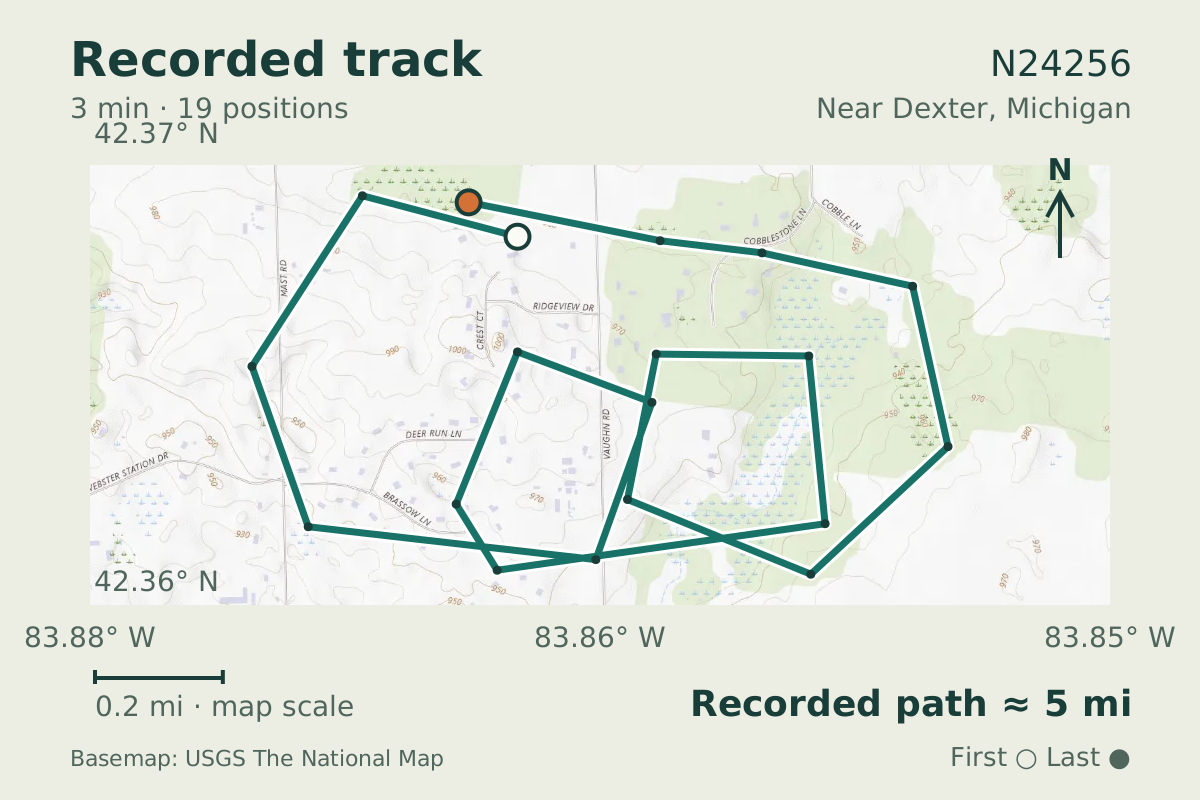
- Replay time · UTC
- —
- Last saved report · UTC
- —
- Recorded path
- —
- Reported ground speed
- —
- Archived altitude
- —
The dot moves between saved positions. Readings are from the last saved report. Recorded path is approximate and excludes gaps. Distances use nautical miles (nmi); speed uses knots (nmi per hour).

Near Dexter, Michigan, a descending circuit put a closed loop into N24256's track on October 7, 2026. Its pressure altitude fell by 2,700 feet during the turn. For the aircraft drawing that shape, the aircraft database records a Cessna 172 Skyhawk identification. The track alone does not establish the purpose of the maneuver.
The Skyhawk was introduced as a successor to the Cessna 170. Its tricycle landing gear puts a wheel at the nose, rather than using a tailwheel.
About the Cessna 172 Skyhawk
- The Cessna 172 Skyhawk is a piston aircraft with one engine and a high wing.
- The Cessna 172 Skyhawk was introduced as a successor to the Cessna 170.
- The Cessna 172 Skyhawk has tricycle landing gear rather than a tailwheel.
Why this was our weekly pick
The Cessna 172’s nosewheel landing gear helped turn a successor to the tailwheel Cessna 170 into a widely used training aircraft.
A design aimed at easier handling
Aircraft type background
The Cessna 172 followed the four-seat Cessna 170, with a conspicuous change underneath: tricycle landing gear replaced the earlier aircraft’s tailwheel arrangement. Cessna called its sprung-steel gear Land-O-Matic. The Smithsonian’s account describes how the company promoted the 172 as an approachable airplane for family flying, including an advertisement in July 1956 that compared flying it with driving. The landing gear is worth noticing because it was central to how Cessna presented the aircraft to prospective pilots. [1]
An early foothold in training
Aircraft type background
The type first flew on June 12, 1955, according to Textron Aviation’s historical account published in 2020. More than 1,100 were built and delivered during its first production year. That early production record gives some context to the 172’s later familiarity at flying schools. The Smithsonian describes it as the trainer in which countless pilots learned to fly, and credits its nosewheel arrangement with helping introduce generations of aviators to tricycle-gear aircraft. Its training history gives an otherwise familiar shape a specific engineering story. [1] [2]
A break in production
Aircraft type background
The 172’s long history includes a manufacturing interruption. The Smithsonian records that Cessna halted single-engine piston aircraft production in 1986 amid product-liability difficulties and other economic pressures. The General Aviation Revitalization Act of 1994 limited manufacturers’ liability, and Cessna resumed building the 172 and 182 in 1997. Those dates are useful context when considering the type’s age: its production history spans distinct periods, separated by a pause that affected Cessna’s broader piston-aircraft business. [3]
What remains uncertain
- The aircraft type comes from a database match. These sources describe the type; they do not independently identify this airframe or establish its mission, occupants, or reason for flying.
- Research was gathered after the observation. Historical aircraft metadata may have changed; the recorded reports remain separate from the background above.
Research sources
- Tales of the Taildraggers — Smithsonian Institution. Aircraft type background; not this airframe or flight. Accessed .
- Iconic Cessna Skyhawk celebrates 65 years since first flight — Textron Aviation. Aircraft type background; not this airframe or flight. Accessed .
- Cessna 152 Aerobat — Smithsonian Institution. Aircraft type background; not this airframe or flight. Accessed .
Recorded data for N24256
| Observed | to |
|---|---|
| Event type | Flight patterns |
| Recorded source | ADS-B, ICAO address |
| Post date | |
| Last revised |
| Type designator | C172 |
|---|---|
| Tail number (registration) | N24256 |
| Callsign | CXK545 |
| ICAO address | A23A93 |
Measurements
Displayed measurements may be rounded.
- Ground speed
- 79.4 kn
- speed over the ground; wind adds to or subtracts from it
- Pressure altitude
- 2,450 ft
- pressure altitude, the figure pilots and controllers use
All measurements and the evidence record
| Ground speed | 79.4 kn |
|---|---|
| Pressure altitude | 2,450 ft |
| Geometric altitude | 2,225 ft |
| Pressure-altitude vertical rate | -192 ft/min |
| Navigation integrity category | 9 |
| Navigation accuracy category | 10 |
| Transponder code | 1200 |
| Episode start altitude | 5,100 ft |
|---|---|
| Episode end altitude | 2,450 ft |
| Episode duration | 179 s |
| Telemetry samples | 19 samples |
| Observed altitude change | -2,650 ft |
| Closed loops | 1 loops |
Evidence version: 671423c1e0c665d3.
Record details
Public event ID: 8b844334-e5bb-4a.
Record revision: 5.