N8704: DC3 type match
The saved aircraft database identifies this aircraft as DOUGLAS DC-3 Dakota. The type match does not independently verify its historical assignment or the purpose of this flight.
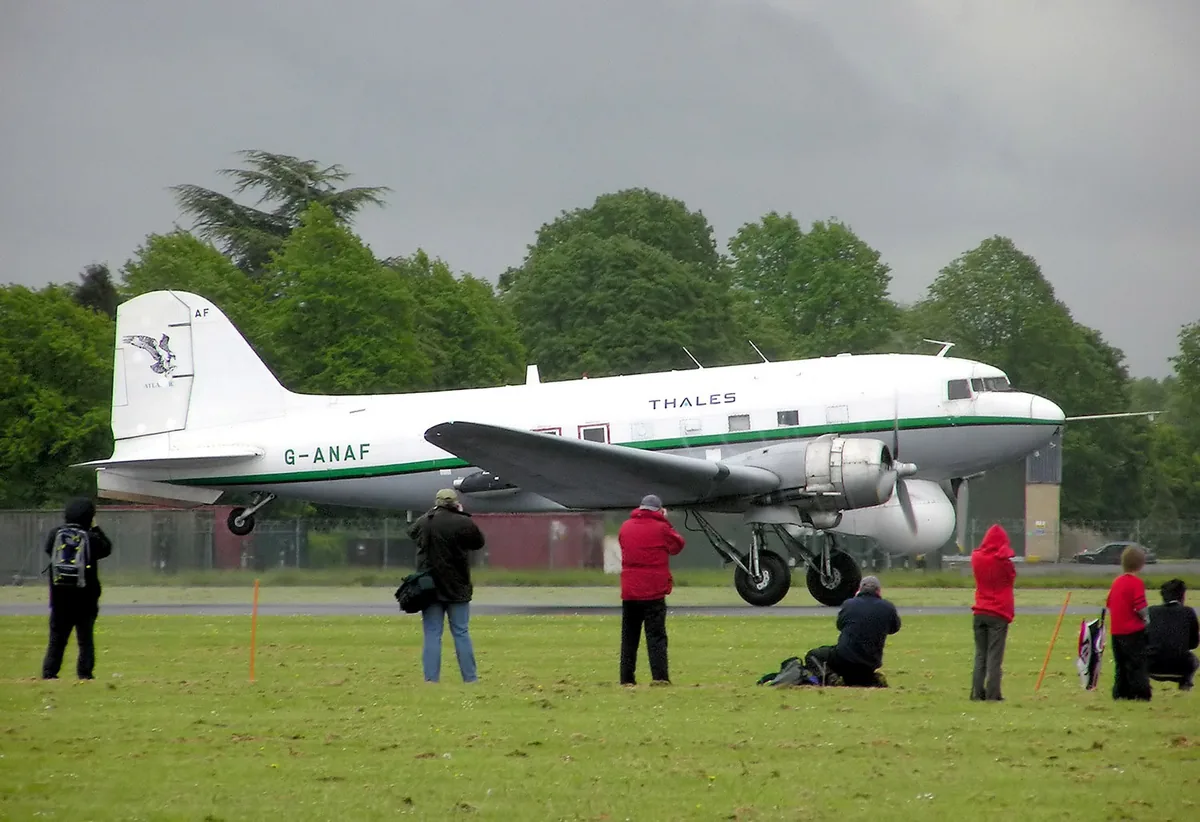
Why this was our weekly pick
The DC-3 match recalls an aircraft that changed the economics of passenger flying, with military derivatives that need to be distinguished from the civil type.
A passenger plane built to pay
Aircraft type background
The Douglas DC-3 first flew on December 17, 1935. Douglas developed it from the DC-2 family after American Airlines sought a larger aircraft suited to overnight travel. The sleeper version, called the Douglas Sleeper Transport, had fourteen berths; the day version carried 21 passengers. American began DC-3 service in September 1936. The Smithsonian says it was the first airliner to operate profitably without government subsidy. That combination of passenger capacity and commercial economics is why the type is worth noticing: it helped make scheduled passenger service a more viable business. [1]
Engineering that traveled into many variants
Aircraft type background
The Smithsonian describes the DC-3 as an all-metal aircraft with cantilever wings, retractable landing gear, trailing-edge flaps and two cowled radial engines. Its strong, multiple-spar wing and metal construction contributed to a sturdy airframe. The familiar Dakota name belongs to a military branch of the family: the U.S. Army’s C-47 was derived from the DC-3, and the British called it the Dakota. C-47 changes included a reinforced floor with cargo fittings and a large two-panel cargo door. Those details belong to the military variant, not every DC-3. The distinction is useful when observing the type: a shared basic design gave rise to aircraft configured for different work. [1] [2]
What remains uncertain
- The aircraft type comes from a database match. These sources describe the type; they do not independently identify this airframe or establish its mission, occupants or reason for flying.
- Research was gathered after the observation. Historical aircraft metadata may have changed; the recorded reports remain separate from the background above.
Research sources
- Douglas DC-3 | National Air and Space Museum — Smithsonian Institution. Aircraft type background; not this airframe or flight. Accessed .
- D-Day and the Douglas C-47 | National Air and Space Museum — Smithsonian Institution. Aircraft type background; not this airframe or flight. Accessed .
Recorded observation
| Observed | to |
|---|---|
| Event type | Unusual aircraft |
| Recorded source | ADS-B, ICAO address |
| Post date | |
| Last revised |
| Aircraft type | DOUGLAS DC-3 Dakota |
|---|---|
| Type designator | DC3 |
| Tail number (registration) | N8704 |
| ICAO address | ABF93A |
Measurements and times
Displayed measurements may be rounded.
| Ground speed | 109.1 kn |
|---|---|
| Archived altitude; reference not retained | 1,925 ft |
| Transponder code | 0000 |
Record details
Public event ID: 705bccba-840f-40.
Record revision: 2.
Evidence version: 28087c3947970623.