75-0556: E3TF type match
The saved aircraft database identifies this aircraft as Boeing E-3B Sentry. The type match does not independently verify its historical assignment or the purpose of this flight.
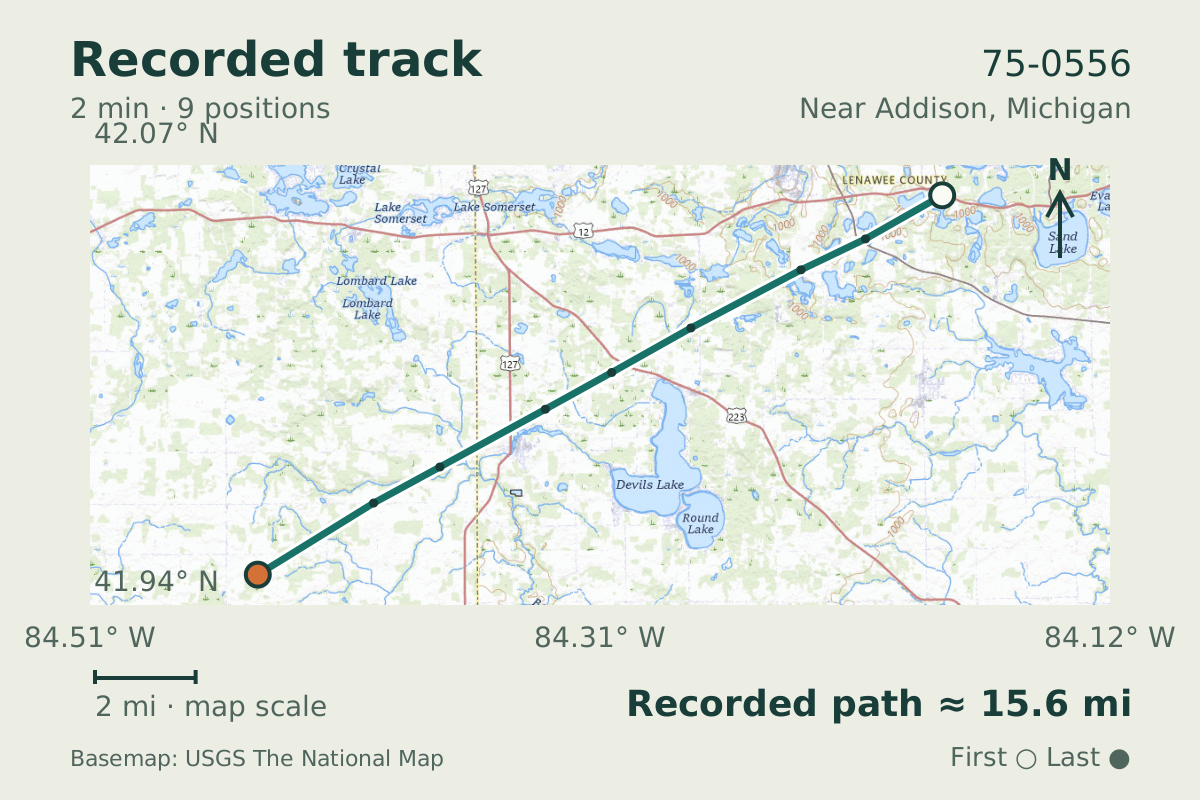
- Replay time · UTC
- —
- Last saved report · UTC
- —
- Recorded path
- —
- Reported ground speed
- —
- Archived altitude
- —
The dot moves between saved positions. Readings are from the last saved report. Recorded path is approximate and excludes gaps. Distances use nautical miles (nmi); speed uses knots (nmi per hour).
Why this was our weekly pick
The E-3 type match points to an airliner-derived aircraft transformed by a rotating radar dome 30 feet across.
A jetliner adapted for surveillance
Aircraft type background
The E-3 Sentry takes the basic shape of a Boeing 707/320 commercial airframe and adds a conspicuous rotating radar dome above the fuselage. The U.S. Air Force describes the dome as 30 feet (9.1 meters) in diameter and six feet (1.8 meters) thick, mounted 11 feet (3.33 meters) above the aircraft on two struts. That arrangement makes the aircraft easy to pick out in the sky, while the radar system is designed to survey over land or water, from the Earth's surface into the stratosphere. The Air Force gives a range of more than 200 miles for low-flying targets, with greater range for aircraft at medium and high altitudes. The elevated radar is the feature worth watching: it turns a familiar commercial-jet outline into a platform built to observe a wide area from above. [1]
From development to service
Aircraft type background
The E-3's development involved more than a decade of competitive fly-offs, prototype design and development before the first aircraft entered U.S. Air Force service in 1977, according to Boeing. The Air Force records that testing on the modified 707/320 airframe began in October 1975 and that the first E-3s reached the 552nd Airborne Warning and Control Wing in March 1977. Boeing's history also describes the aircraft as a 707 airframe fitted with a rotating radar installation, and notes that E-3 systems were upgraded over time, including radar and computing. The combination of an airliner-derived structure and a specialized sensor installation makes the Sentry an instructive spot: its unusual silhouette is a visible clue to how much of its design serves a mission beyond ordinary transport. These sources describe the E-3 Sentry generally; they do not establish equipment unique to the E-3B variant. [2] [3]
What remains uncertain
- The aircraft type comes from a database match. These sources describe the type; they do not independently identify this airframe or establish its mission, occupants or reason for flying.
- Research was gathered after the observation. Historical aircraft metadata may have changed; the recorded reports remain separate from the background above.
Research sources
- E-3 Sentry (AWACS) — U.S. Air Force. Aircraft type background; not this airframe or flight. Accessed .
- E-3 Airborne Warning And Control System — Boeing. Aircraft type background; not this airframe or flight. Accessed .
- Air Force celebrates 30th anniversary of E-3 Sentry — U.S. Air Force. Aircraft type background; not this airframe or flight. Accessed .
Recorded observation
| Observed | to |
|---|---|
| Event type | Unusual aircraft |
| Recorded source | Multilateration (MLAT) |
| Post date | |
| Last revised |
| Aircraft type | Boeing E-3B Sentry |
|---|---|
| Type designator | E3TF |
| Tail number (registration) | 75-0556 |
| ICAO address | AE11D6 |
Measurements and times
Displayed measurements may be rounded.
| Archived altitude; reference not retained | 32,025 ft |
|---|---|
| Transponder code | 3562 |
Record details
Public event ID: db93d604-b5df-4e.
Record revision: 2.
Evidence version: bf07eb6f711c5949.