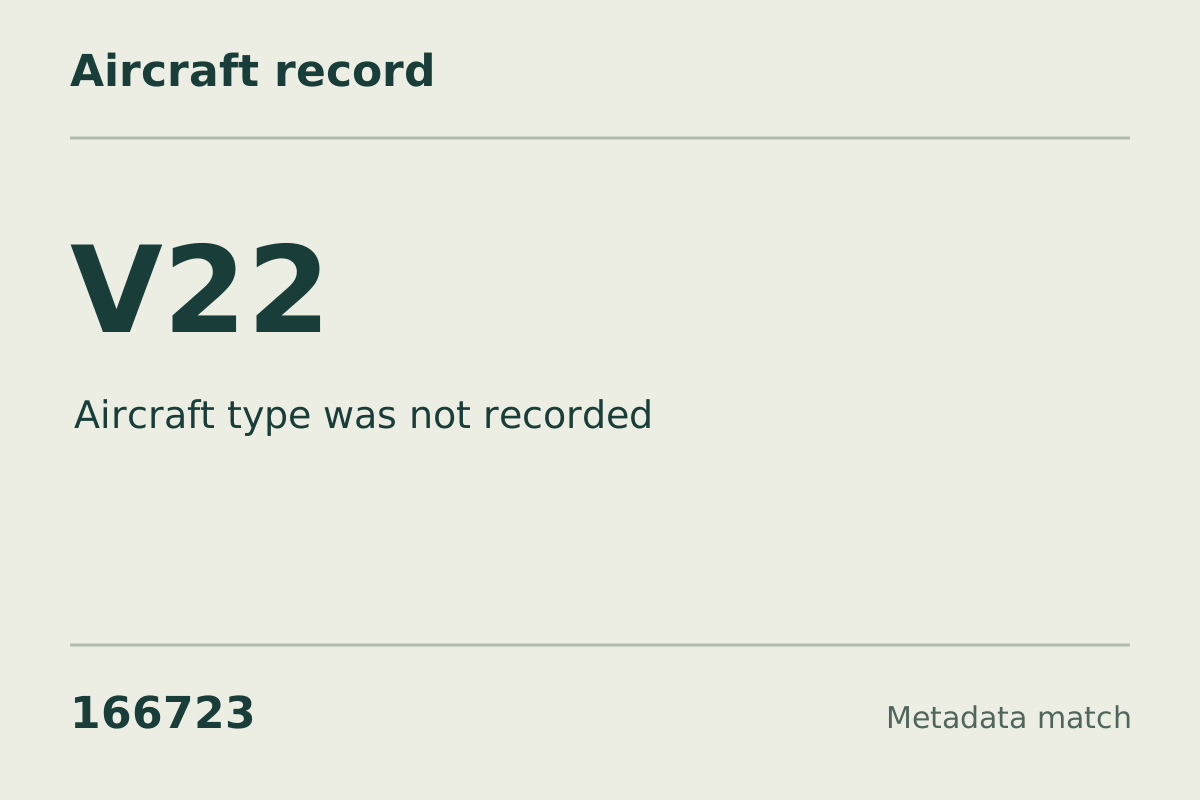
166723: V22 type match
The saved aircraft database identifies this aircraft as V22. The type match does not independently verify its historical assignment or the purpose of this flight.
Why this was our weekly pick
The V-22’s rotating nacelles combine vertical flight with turboprop cruise. Its development story stretches back decades before the Osprey’s first flight.
A helicopter that changes mode
Aircraft type background
The V-22’s defining feature is its pair of wingtip nacelles, each carrying an engine and proprotor. Pointed upward, the proprotors provide vertical lift for takeoff, hovering and landing. In forward flight, the nacelles rotate ahead, letting the aircraft fly like a turboprop. That shift gives the Osprey a distinctive profile: its rotors are doing a different job depending on their angle. The wing also rotates for compact storage aboard ship. The combination is worth noticing because the aircraft brings helicopter-style vertical flight and fixed-wing-style cruise into one airframe. [1] [2]
A long development path
Aircraft type background
The Osprey grew from decades of tiltrotor experiments. The Bell XV-3 first flew on August 11, 1955, and completed 110 transitions between helicopter and airplane modes from December 1958 to July 1962. The Air Force Test Center describes the XV-3 program as demonstrating the movable-rotor concept that later informed the V-22. In December 1981, after a review of vertical and short takeoff and landing technology, the services were directed to pursue a joint medium-lift aircraft program using tiltrotor technology. The V-22 first flew on March 19, 1989. Those dates help explain why a seemingly simple motion, turning the rotors forward, rests on a long history of engineering trials. [3] [4]
Variants have their own equipment
Aircraft type background
The V-22 family includes service-specific versions, so details from one variant should not be applied to every Osprey. The Air Force CV-22 fact sheet describes its nacelles rotating forward after takeoff and lists systems for operating in austere conditions. The Air Force’s 2007 history also notes CV-22-specific equipment, including terrain-following and terrain-avoidance radar, auxiliary fuel tanks and an electronic-warfare suite. That distinction matters when observing the type: the shared tiltrotor layout is the family resemblance, while some installed equipment belongs to a particular version. [2] [4]
What remains uncertain
- The aircraft type comes from a database match. These sources describe the type; they do not independently identify this airframe or establish its mission, occupants or reason for flying.
- Research was gathered after the observation. Historical aircraft metadata may have changed; the recorded reports remain separate from the background above.
Research sources
- Beyond the Speed of Sound: Highlights of Development Testing at AEDC — U.S. Air Force. Aircraft type background; not this airframe or flight. Accessed .
- CV-22 Osprey — U.S. Air Force. Aircraft type background; not this airframe or flight. Accessed .
- May 21, 1959: Major Robert C. Ferry Piloted the Bell XV-3 Convertiplane on its First Air Force Flight — U.S. Air Force. Aircraft type background; not this airframe or flight. Accessed .
- The Long Road: AFOTEC's Two-Plus Decades of V-22 Involvement — U.S. Air Force. Aircraft type background; not this airframe or flight. Accessed .
Recorded observation
| Observed | |
|---|---|
| Event type | Unusual aircraft |
| Recorded source | ADS-B, ICAO address |
| Post date | |
| Last revised |
| Type designator | V22 |
|---|---|
| Tail number (registration) | 166723 |
| ICAO address | AE2BC5 |
Measurements and times
Displayed measurements may be rounded.
| Ground speed | 130.8 kn |
|---|---|
| Archived altitude; reference not retained | 2,225 ft |
| Transponder code | 0000 |
Record details
Public event ID: 2a298b23-fc14-49.
Record revision: 2.
Evidence version: 1f45b04136da34f3.