163920: an E-6B Mercury database match
The saved aircraft database identifies this aircraft as Boeing E-6B Mercury. The type match does not independently verify its historical assignment or the purpose of this flight.
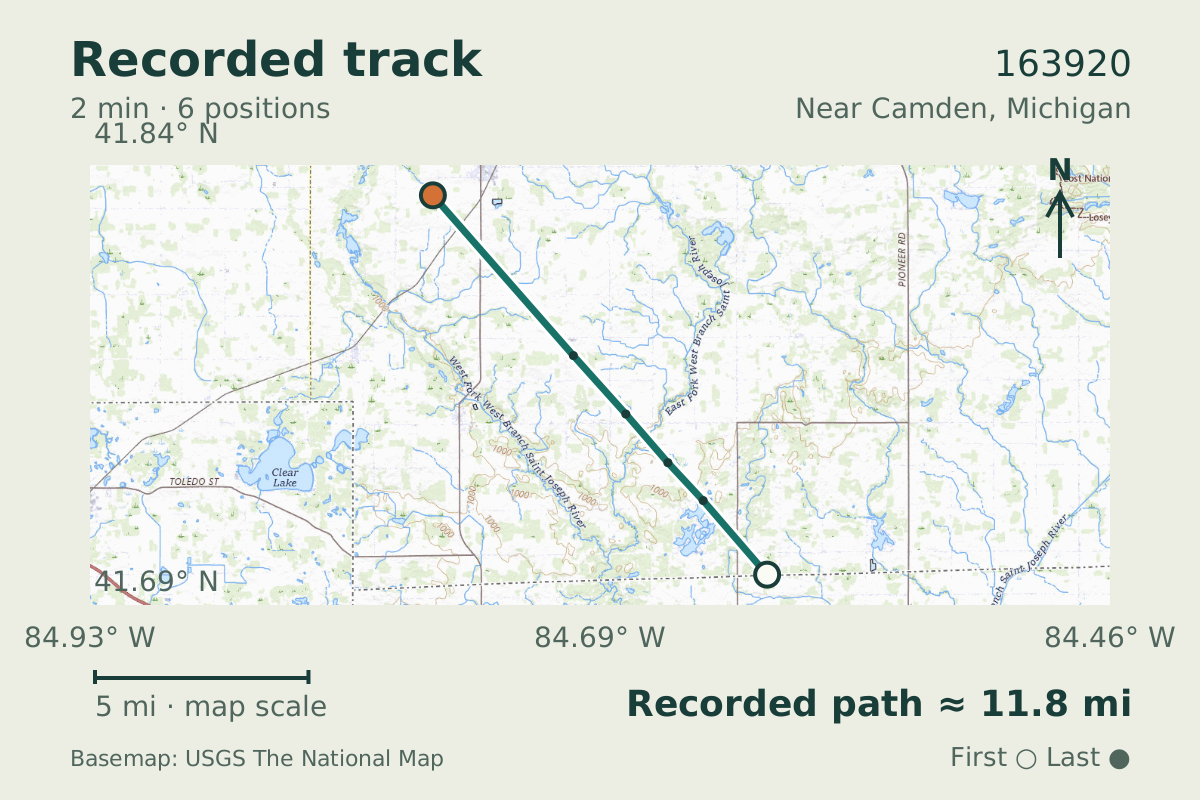
- Replay time · UTC
- —
- Last saved report · UTC
- —
- Recorded path
- —
- Reported ground speed
- —
- Archived altitude
- —
The dot moves between saved positions. Readings are from the last saved report. Recorded path is approximate and excludes gaps. Distances use nautical miles (nmi); speed uses knots (nmi per hour).
Why this was our weekly pick
An E-6B Mercury database match stood out among the week's observations. This 707-derived aircraft type carries specialized communications equipment and serves as an airborne command post.
What the Mercury was built to do
Aircraft type background
Naval Air Systems Command describes the E-6B as an aircraft built to relay strategic communications and provide an airborne command post. Its predecessor, the E-6A, adapted Boeing's commercial 707 design for the Navy's TACAMO communications mission. The E-6B added staff positions and other equipment for the command-post role. NAVAIR dates the first E-6B acceptance to December 1997 and the start of its dual mission to October 1998. [1]
A 707 with trailing wire antennas
Aircraft type background
Boeing's historical account records 16 E-6 deliveries to the Navy between 1989 and 1992. They were assembled on the production line used for the E-3 Sentry, another aircraft based on the 707. Boeing describes two trailing wires used for very-low-frequency transmissions to support communications with ballistic-missile submarines. These are features of the aircraft type; the saved observation does not show whether those systems were in use. [2]
What the type match tells us
Interpretation
The saved aircraft database associates the observed address with registration 163920 and the E-6B Mercury type. The references explain that type's design and roles. They do not identify the purpose, crew or communications activity of the September 29 observation. The database association itself has not been independently verified against a dated airframe record. [2] [1]
What remains uncertain
- The registration and type are aircraft-database associations, not independent historical identity verification.
- Neither the track nor these type references establishes the flight purpose, occupants or use of onboard communications systems.
- The archive has missing dates and a partial final date; this is a selection from available observations, not a complete record of regional traffic.
Research sources
- E-6 Mercury: Boeing historical product account — Boeing. E-6 production history and type equipment; no individual airframe or flight-purpose verification. Accessed .
Recorded observation
| Observed | to |
|---|---|
| Event type | Unusual aircraft |
| Recorded source | Multilateration (MLAT) |
| Post date | |
| Last revised |
| Aircraft type | Boeing E-6B Mercury |
|---|---|
| Type designator | E6 |
| Tail number (registration) | 163920 |
| ICAO address | AE0412 |
Measurements and times
Displayed measurements may be rounded.
| Archived altitude; reference not retained | 11,875 ft |
|---|---|
| Transponder code | 0000 |
Record details
Public event ID: 8e10c0a0-9c4e-48.
Record revision: 2.
Evidence version: ed372173e980cfb3.